Key takeaways
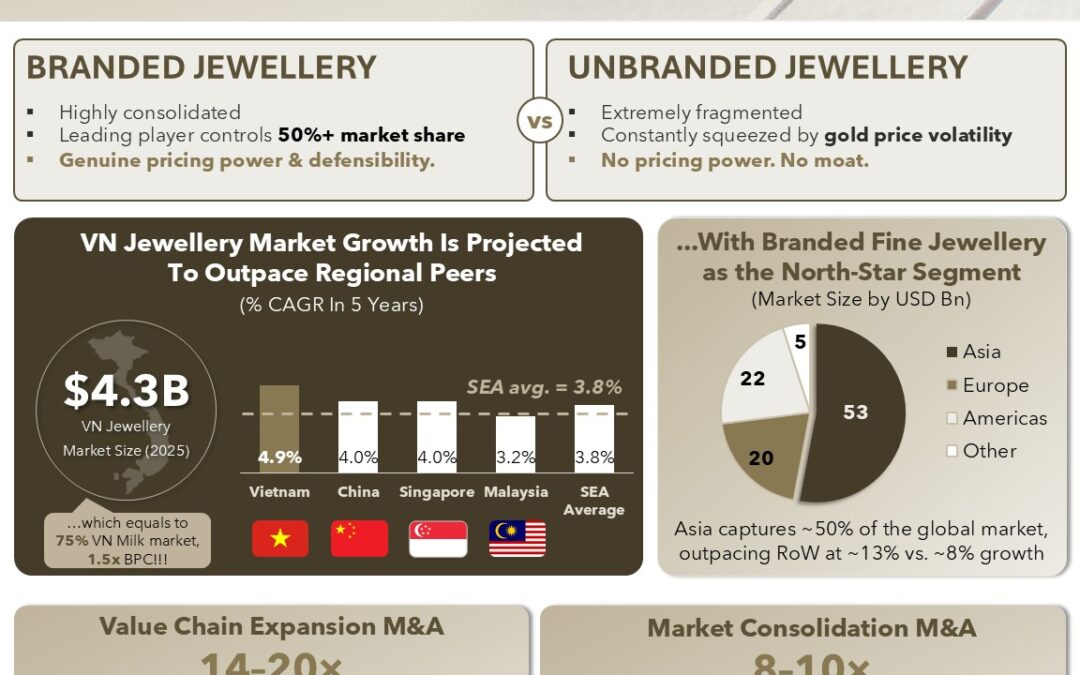
- The scale: Vietnam’s jewelry market is worth ~US$4.3bn — about 75% of the country’s total dairy market and roughly 1.5× its beauty & personal care market.
- The tailwind: ~5% CAGR through 2030, underpinned by household income rising from ~US$5,200 to ~US$6,900 per year.
- The real story: The market is bifurcating fast — a fragmented unbranded base squeezed by gold prices, versus a consolidated branded tier where the leader already holds 50%+ share and 70%+ national coverage.
- The M&A read: Globally, value-chain expansion deals price at ~14–20x EV/EBITDA and consolidation deals at ~8–10x — with Asia, ~50% of the branded fine-jewellery market, growing fastest and shifting premium.
A US$4.3bn market hiding in plain sight
The total addressable market is growing at roughly 5% CAGR through 2030, underpinned by household income rising from about US$5,200 to US$6,900 per annum. But the headline growth rate masks a far more interesting structural story underneath.
The market is bifurcating, fast
Beneath the single TAM number sit two markets that behave nothing alike, and the gap between them is widening.
The branded tier is where the value accrues — and where the strategic question gets interesting. With one dominant incumbent, the obvious question is whether there is genuine room to challenge it, or a defensible niche a focused player could own. That is precisely the kind of structural set-up that rewards a differentiated brand and disciplined capital.
From Vietnam to Asia: the bigger story
Vietnam does not sit in isolation. Asia accounts for roughly half of the global branded fine-jewellery market and is growing at about 10–14% annually, versus 5–10% for the rest of the world. Just as importantly, the region is structurally shifting toward premium and luxury tiers, exactly the direction a rising-income market like Vietnam tends to travel as it matures.
Through a global M&A lens: two theses, two price tags
How the world’s strategics have paid for jewelry assets tells you what each thesis is worth. We see two distinct playbooks — and the premium tracks the strategic logic.
Headline growth gets you in the room. Structure is what gets the deal done.
Put the pieces together — a US$4.3bn market, a steady income tailwind, a fragmented base, a single dominant brand, and a regional shift toward premium — and Vietnam’s jewelry sector looks less like a sleepy consumer category and more like an under-priced platform opportunity. The investors who map the structure first will be the ones positioned when the rest of the market wakes up.